

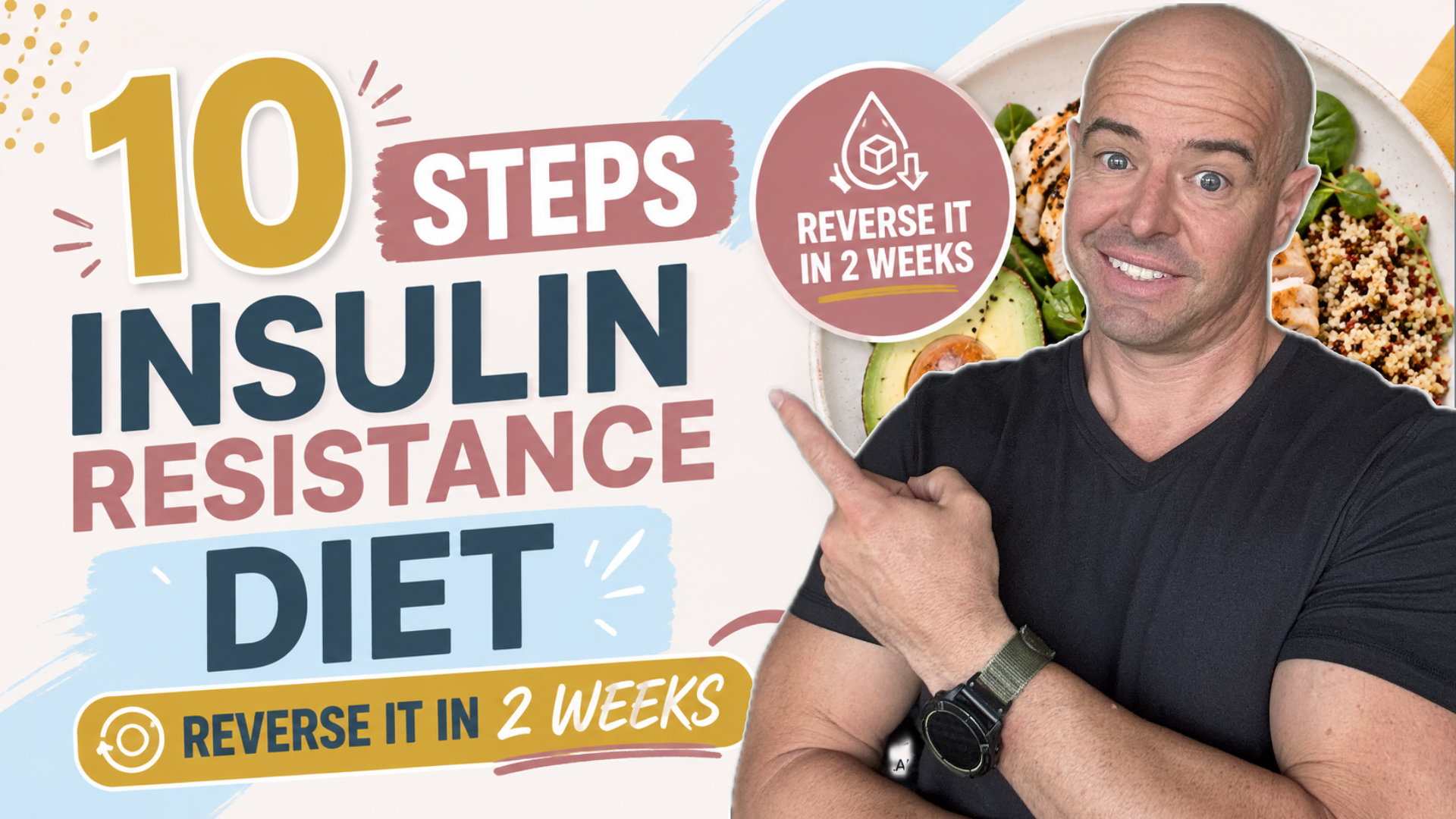
WATCH VIDEO BELOW
The Insulin Resistance Diet: 10 Steps to Reverse It (Especially If You’re a Woman Over 40)
If you’ve been eating well, moving your body, and doing everything you’re supposed to do, and your body still holds onto fat, especially around your belly…
You are not broken.
I need you to hear that before anything else.
You’re not lazy. You’re not lacking willpower. Your body is doing exactly what it was designed to do based on the hormonal signals it’s getting.
I’m Dr. Cody Golman. I’ve spent the last decade working one-on-one with women over 40 who felt exactly like you feel right now. And I kept getting the same question over and over:
“Dr. Cody, what do I actually eat if I’m insulin resistant?”
Not another “eat this, not that” list. A real explanation of what’s happening inside your body.
So that’s what you’re getting here. Ten steps. Science-backed. Some of them you’ve never heard before.
And stick with me, because about halfway down I’m going to share the one shift that changes everything — the thing that finally gets women out of the insulin trap for good.
Let’s go.
Insulin Resistance Explained (In Plain English)
First, let’s clear something up. Insulin resistance is not your fault.
It builds slowly. Quietly. Over years.
High-stress seasons. Bad sleep. The sugar you leaned on when life got heavy. The skipped meals. The stress eating at 9pm after everyone finally went to bed.
Sound familiar? Yeah. Me too. We’ve all been there.
What Insulin Actually Does
Insulin is the hormone that moves sugar out of your blood and into your cells. It’s a delivery driver. That’s the job.
But when your cells get flooded with insulin over and over for years, they stop listening. They stop answering the door.
So your pancreas does the only thing it knows to do, it pumps out more.
And a high-insulin body gets one very clear message:
Hold on to fat. We’re under threat.
That’s it. That’s the whole trap.
So if you’ve been gaining weight while eating “healthy”, this is probably why.
Why This Hits Women Over 40 Harder
Here’s what makes insulin resistance weight loss for women so different after 40:
- Estrogen and progesterone shift. These hormones help regulate how your body handles glucose. As they change, insulin sensitivity often drops with them.
- Muscle mass declines. Muscle is where a huge amount of your glucose gets used. Less muscle means less demand for that sugar, so it stays in circulation longer.
- Cortisol runs higher. Perimenopause plus career plus kids plus aging parents equals a nervous system that rarely gets to stand down.
- Sleep gets worse. Night sweats, 3 am wake-ups, and broken sleep all measurably reduce insulin sensitivity the very next day.
None of that is a character flaw. It’s physiology. And physiology responds to the right inputs.
Insulin Resistance Symptoms: What to Actually Look For
Most women don’t get told they’re insulin resistant. They just get told to “eat less and move more” and sent home.
Here are the insulin resistance symptoms I see most often in the women who come to me:
- Belly weight that won’t budge, even when the rest of your body responds
- Energy crashes, especially between 2 pm and 4 pm
- Cravings for sugar or carbs that feel like more than a preference
- Constant hunger, even an hour or two after a full meal
- Brain fog and trouble finding words
- Skin tags, or darker velvety patches on the neck, armpits, or groin
- Difficulty losing weight on programs that used to work
- Elevated fasting glucose, triglycerides, or A1C on bloodwork
- Poor sleep, or waking up between 2 am and 4am
- Irregular cycles or worsening PMS
If you’re nodding along at four or more of these, keep reading. And ask your doctor for a fasting insulin test, not just fasting glucose. Fasting glucose is often the last marker to move. Fasting insulin tells you what’s happening years earlier.
The 10-Step Insulin Resistance Diet
This is the framework. It’s not a punishment plan. It’s a signal plan.
Step 1: Stop Eating Less, Start Lowering Your Insulin Load
This is the biggest reframe I give my clients.
It’s not about eating less. It’s about spiking insulin fewer times per day.
Every time you eat something that shoots your blood sugar up fast, your body dumps insulin to handle it. Do that six, eight, ten times a day for twenty years? Your cells tune it out.
Your micro-win today: swap one sweetened drink or snack for a whole food.
- Water with lemon
- Herbal tea
- A piece of fruit with some protein and fat alongside it
Small? Yes. But these are the wins that stack.
Step 2: Watch Glycemic Load, Not the Calorie Label
Calories tell you almost nothing about what a food does to your hormones.
A 100-calorie snack pack of cookies and 100 calories of almonds do wildly different things inside your body. Same number. Completely different hormonal outcome.
Foods that raise blood sugar slowly and gently:
- Lentils and beans
- Berries
- Sweet potatoes
- Winter squash
- Steel-cut oats
- Non-starchy vegetables
Less insulin needed. Fewer cravings three hours later. Better mood.
And yes, your jeans fit better.
Low-glycemic eating improves insulin sensitivity and metabolic health far more effectively than just cutting calories. Every time.
Step 3: Protein First. Every Meal.
Protein stabilizes your blood sugar, keeps you full, and protects your lean muscle.
And muscle matters more than almost anything after 40. When you lose muscle, your metabolism slows down. Period.
With my clients, we usually start around 30 to 40 grams of protein per meal. That one change alone shifts hunger, energy, and cravings dramatically.
Your micro-win: at your next meal, eat your protein first. Before the carbs. Before the bread.
Then notice how much less you want everything else.
Step 4: Fat Is Not the Enemy
Fat got demonized for thirty years and it set a whole generation of women back.
Here’s the truth: fat has the lowest insulin response of any macronutrient. The lowest.
- Avocado
- Olive oil
- Salmon and fatty fish
- Nuts
- Seeds
These slow your digestion, steady your blood sugar, and kill hunger without the crash.
And they taste incredible. Which matters, because you’re not going to stick with food you hate.
Step 5: Fiber Is Your Metabolic Traffic Light
Fiber slows glucose absorption and feeds your gut microbiome.
- Chia seeds
- Raspberries
- Leafy greens
- Lentils
- Broccoli
- Flaxseed
When you get enough fiber, your whole system calms down. Instead of slamming into a sugar wall at 3pm, your body gets a smooth on-ramp.
Most women I work with are getting less than half the fiber they need. Fixing that alone changes their afternoons.
Step 6: Hydration. Yes, Really.
I know. It sounds too simple to matter.
But dehydration raises your stress hormones, and stress hormones wreck blood sugar balance.
- Aim for roughly half your body weight in ounces every day
- Drink 20 ounces of water before your coffee tomorrow morning
- Add a pinch of mineral salt if you’re active or sweating
Your metabolism notices. I promise.
Step 7: Meal Timing, Not Fasting
Let me be clear about this, because it’s where a lot of women over 40 get hurt.
I’m not talking about extreme fasting windows. That’s not what we do at FAST40, and I don’t recommend it for most women in this season of life. Aggressive fasting is a stress signal, and stress is already half the problem.
I’m talking about rhythm. Consistency.
A 12-hour overnight break between dinner and breakfast.
Most of my clients stop eating around 7pm and eat again around 7am. That’s it.
That simple rhythm:
- Stabilizes blood sugar overnight
- Improves morning energy
- Shuts down the late-night snacking that spikes insulin when your body should be repairing
The One Shift Most Women Never Hear About
Okay. You’ve got the foundation. Now here’s the part most people never hear from their doctor.
The number one reason insulin resistance keeps you stuck?
High Insulin Is a Stress Signal
Let that land for a second.
When your nervous system is stuck in fight-or-flight, from chronic stress, from blood sugar swings, from five hours of broken sleep, your body defends fat.
It stores it. It refuses to let it go, because as far as your biology is concerned, you’re under attack and you might need that energy to survive.
You can eat perfectly and still not lose a pound if your body doesn’t feel safe.
Read that again if you need to.
Your Body Has to Feel Safe Enough to Let Go of Fat
Once your blood sugar is stable, your nervous system is calm, and your hormones are supported? Your metabolism flips. It shifts into fat-burning mode almost on its own.
Research on stress physiology backs this up, sympathetic nervous system activation blunts insulin sensitivity and keeps glucose elevated even in people who are eating well.
So this was never about punishment. Or discipline. Or being harder on yourself.
It’s about giving your body the signal that it’s safe to release what it’s been holding.
That’s the whole game. That’s why my clients finally get results after years of trying.
What “Feeling Safe” Actually Looks Like
Practically speaking, in your real life:
- Sleep — 7 to 8 hours, in a dark, cool room, on a consistent schedule
- Eating enough — undereating is a threat signal, not a solution
- Downregulating daily — ten minutes of walking, breathwork, or sitting in silence
- Strength training — 2 to 3 times a week, which builds the muscle that soaks up glucose
- Sunlight in the morning — it anchors your cortisol rhythm, which anchors everything else
The Insulin Resistance Diet: Steps 8, 9, and 10
Step 8: Cut Artificial Sweeteners and Processed Seed Oils
These two confuse your metabolism and keep cravings alive.
Artificial sweeteners like sucralose and aspartame may not spike blood sugar in the moment, but research suggests they can impair glucose tolerance and alter gut bacteria in ways that promote insulin resistance over time.
Processed seed oils, soybean, corn, canola, cottonseed- are loaded with omega-6 fats that drive inflammation and oxidative stress. Both of which directly interfere with insulin signaling.
So that diet soda you’ve been counting as a “free” drink? It may not be free at all.
Swap toward:
- Olive oil, avocado oil, butter, ghee, coconut oil
- Whole-food sweetness: berries, cinnamon, a small amount of raw honey
- Sparkling water with lime instead of diet soda
Step 9: Look Beyond the Scale
Track your waist. Track how your clothes fit. Track your energy. Track your sleep.
Because here’s what happens: many women reverse insulin resistance and drop two inches before the scale moves much at all.
That’s because visceral fat, the fat that wraps around your organs, is usually the first to go when insulin normalizes. It’s also the most dangerous fat you carry.
Reductions in visceral fat improve metabolic function and lower cardiovascular risk even when total body weight barely changes.
Better things to measure:
- Waist circumference at the navel
- How a specific pair of jeans fits
- Afternoon energy on a 1–10 scale
- Cravings frequency
- Sleep quality and how you feel at 7am
If the scale is the only thing you’re measuring, you’re going to miss the win that’s actually happening.
Step 10: Patience and Personalization
Insulin resistance is not one-size-fits-all.
- I’ve had clients transform their insulin sensitivity just by ending late-night snacking
- Others did it by fixing their sleep
- Others by removing one inflammatory food
Small changes to sleep, eating windows, or meal composition can produce measurable improvements in fasting insulin and A1C in as little as two weeks.
Two weeks.
The key isn’t perfection. It’s consistency. And it’s approaching your body with curiosity instead of punishment.
Your body isn’t fighting you. It’s adapting to survive.
Change the signals, and your body changes with you.
Insulin Resistance Treatment: What to Expect and How Fast
A realistic timeline for insulin resistance reversing, based on what I see with clients:
Weeks 1–2
- Cravings begin to soften
- Afternoon energy stabilizes
- Sleep starts to deepen
- Fasting insulin can begin to move
Weeks 3–6
- Waist measurement starts to drop
- Clothes fit differently
- Hunger becomes predictable instead of frantic
- Mood and mental clarity improve
Weeks 8–12 and Beyond
- Meaningful scale movement for most women
- Bloodwork improvements, A1C, triglycerides, fasting insulin
- Visceral fat reduction
- Energy that holds all day without a crash
Medical insulin resistance treatment sometimes includes medication, and that’s a conversation to have with your physician. But food, sleep, stress, and movement are the foundation underneath all of it. Medication without those changes is a patch, not a fix.
Frequently Asked Questions
Can insulin resistance be reversed?
For most people, yes insulin resistance is highly responsive to lifestyle change. It’s not a permanent diagnosis. It’s a pattern your body learned, and patterns can be unlearned when the signals change.
What is the best diet for insulin resistance weight loss?
The one that lowers your insulin load and that you’ll actually stick with. In practice that means adequate protein, healthy fats, high fiber, low-glycemic carbohydrates, and a consistent eating rhythm, not extreme restriction.
Do I have to do keto to fix insulin resistance?
No. Keto can work for some women, but it isn’t required, and for many women over 40 it’s unnecessarily restrictive. Lowering glycemic load and stabilizing meal rhythm gets most of the benefit without the rigidity.
Should I fast to reverse insulin resistance?
Long or aggressive fasting is not what I recommend for most women over 40. A gentle 12-hour overnight break is enough for most people. Extreme fasting can raise cortisol and work directly against you.
How do I get tested?
Ask your doctor for a fasting insulin test alongside fasting glucose and A1C. A HOMA-IR calculation, which uses fasting insulin and glucose together, gives you an even clearer picture.
Your One Thing for Today
Here’s what I want you to do today. One thing.
Replace one processed food with a real whole food.
- Sugary yogurt → Greek yogurt with cinnamon
- Soda → sparkling water and lime
- Granola bar → a handful of almonds and a hard-boiled egg
Then just notice how you feel in a few days. Your insulin system responds fast when you give it the right signals.
Ready for the Next Step?
If this hit home, if you’ve been feeling like your body stopped cooperating somewhere around 40 and you don’t know why, come join us in Fit Over 40.
It’s my free community where I go deeper on all of this: hormone resets, real food strategies, and the mindset work that makes it stick. It costs you nothing, and you’ll be around a whole lot of women who get exactly what you’re going through.
And if you’re past the point of wanting more information, if you want a plan built specifically for your body, your hormones, and your life, then book a one-on-one call with our team.
We’ll sit down, look at what’s actually going on with you, and tell you honestly whether we can help.
No pressure. No pitch. Just a conversation.
I’m Dr. Cody Golman.
And remember, your body isn’t against you. It’s been waiting for you to give it what it needs. Let’s do this together.
This article is for educational purposes and is not a substitute for individualized medical advice. Talk with your physician before making changes, especially if you’re taking medication for blood sugar, thyroid, or blood pressure.


