

WATCH VIDEO BELOW
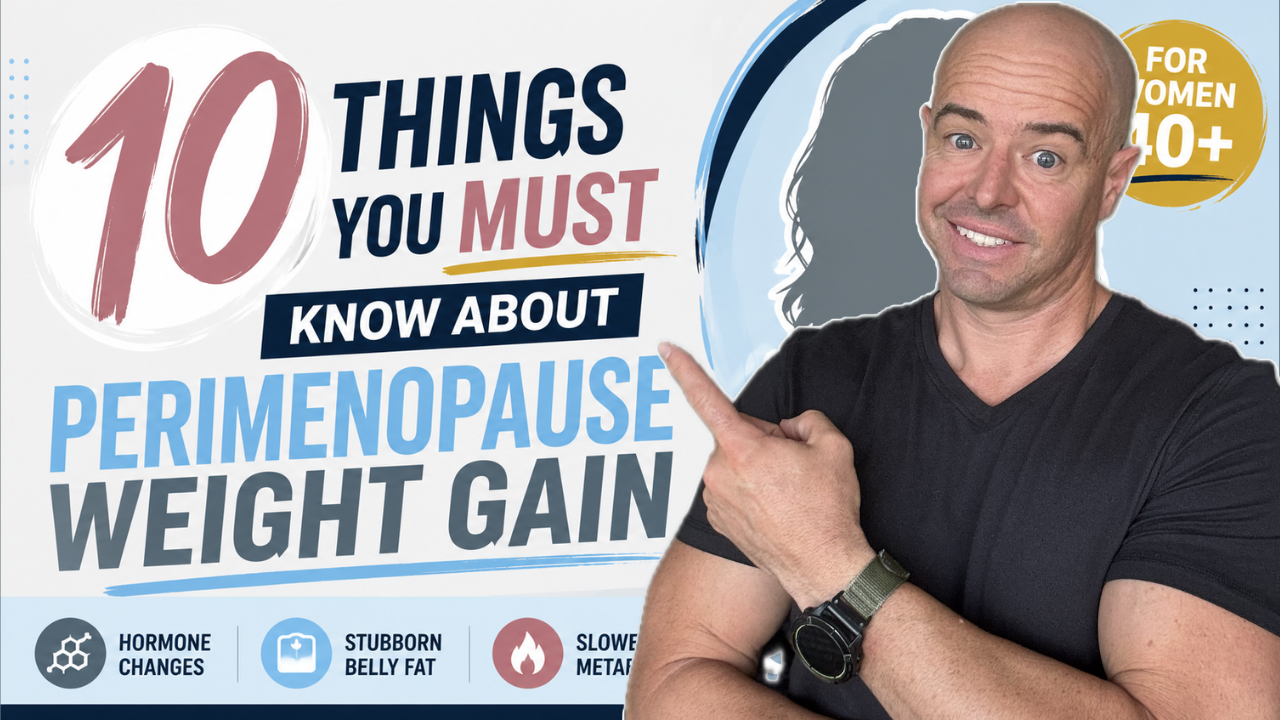
Perimenopausal Weight Gain: 10 Things You Must Know (and How to Finally Lose It)
Perimenopausal weight gain. If that phrase makes your chest tighten a little, or maybe a lot, I want you to know something right here at the start: you are not broken, and your body is not malfunctioning.
You are navigating a biological phase that literally rewires how your metabolism, hormones, and nervous system work. And what worked for weight loss in your 30s will not work the same way during perimenopause.
I decided to write this because so many women in our Fit Over 40 community keep asking me the same question: why won’t my body cooperate anymore? I’ve seen plenty of content out there giving quick tips without explaining what’s actually going on, and that leaves you feeling confused, overwhelmed, and stuck. So I want to walk you through the real science and strategy behind perimenopausal weight gain, because understanding what’s happening in your body is half the battle of your perimenopausal weight loss journey.
I’m Dr. Cody, founder of FAST40, and I’ve worked with thousands of women inside our Fit Over 40 community who felt exhausted, stuck, and ready to give up. I promise, your experience is more common than you think. Let’s get into it.
Why Perimenopausal Weight Gain Happens (And the 10 Solutions That Actually Work)
1. It’s Not a Willpower Problem, It’s a Hormone Problem
Perimenopausal weight gain is not about lack of willpower or character. It’s not about eating too many cupcakes.
The old “calories in, calories out” model worked reasonably well before because your hormones were cooperating. But during perimenopause, your estradiol, the most active form of estrogen, declines, and that sets off a cascade of hormonal changes.
Estrogen acts like the conductor of your metabolic orchestra. It helps insulin and leptin signal properly, supports thyroid output, and regulates where fat is stored. Research shows estrogen helps regulate insulin sensitivity and fat distribution, so when estrogen drops, your body becomes more efficient at storing fat, especially around the belly, even if your calories and activity level haven’t changed.
At the same time:
- Leptin (the hormone that tells your brain you’re full) becomes less sensitive, making hunger stronger without increased eating
- Ghrelin (the hunger-stimulating hormone) can rise
- Cortisol (your stress hormone) becomes more dominant
This combination makes your body want to hold onto fat, especially around your midsection. Many women respond by eating less and exercising more, but that backfires. Undereating signals stress to your body, raises cortisol, slows thyroid function, and can actually increase fat storage.
Micro-win: Stop restricting calories. Start eating more nutrient-dense foods that signal safety to your metabolism.
2. Ditch Calorie Counting, Build Balanced Plates Instead
One of the most effective perimenopausal weight gain solutions isn’t more restriction; it’s better structure.
I don’t promote calorie counting because it tends to become neurotic and guilt-based. Instead, I teach women to weigh their food and build meals balanced for their biology:
- About 4 ounces of lean protein (chicken, fish, tofu) as a starting point, some women need 8–12 ounces depending on activity level
- Generous vegetables
- A healthy carbohydrate you actually enjoy
Mapping your plate this way gives your body what it needs to support thyroid and metabolic hormones instead of signaling starvation. It takes the guesswork out and helps you spot patterns without obsessing over every number.
3. Prioritize Protein and Real Strength Training
As you age, you lose muscle mass at about 8% per decade after age 30. Muscle isn’t just there for strength or aesthetics, it’s your body’s best metabolic organ. It pulls glucose out of your bloodstream even when insulin sensitivity is lower, which becomes especially important as insulin resistance creeps up during perimenopause.
This is one of the biggest reasons women over 40 gain weight despite eating “less”, their bodies are simply burning fewer calories at rest because muscle mass has declined.
Real strength training tells your body it needs that muscle. This doesn’t require high intensity; it means lifting weights that create real muscle fatigue. Think three sets where the last two reps feel genuinely tough. If you’ve only been toning with 5- or 10-pound dumbbells, your body isn’t getting the signal it needs to change.
Research in the Journal of Clinical Endocrinology and Metabolism shows that resistance training improves body composition and insulin sensitivity in midlife women, helping shift the body toward fat loss instead of fat storage.
4. Hydration Matters More Than You Think
Water plays a bigger role in your metabolic set point than most people realize. Adequate hydration supports digestion, cellular function, and appetite regulation.
- Aim for about half your ideal body weight in ounces of water each day (140 lbs → ~70 oz)
- If you’re intermittent fasting, add electrolytes to support adrenal function and keep you energized
Water tells your body it’s not in danger, which is essential for signaling safety and allowing fat burning to happen.
5. Use Intermittent Fasting as a Tuning Tool, Not a Hammer
Intermittent fasting can be a helpful part of your perimenopausal weight loss toolkit, but it needs to be gentle:
- Start with a 12-hour eating window (e.g., finish dinner at 6 pm, eat again at 6 am)
- Expand gradually to 13–14 hours as you feel comfortable
- Avoid jumping straight into 16- or 18-hour fasts; for many women in this phase, that causes headaches, fatigue, or irritability, which signals stress rather than safety
Research supports that time-restricted eating can improve insulin sensitivity and reduce visceral fat in women over 40, but implementation needs to be gradual and tailored to your biology.
6. Help Your Nervous System Feel Safe
Here’s the piece almost no one talks about, and it may be the single most important perimenopausal weight gain solution: your body must feel safe enough to let go of fat.
It’s not about harder workouts. It’s not about eating less. It’s about helping your nervous system and metabolism feel secure enough to stop storing and start releasing.
Your nervous system runs on two basic states: fight-or-flight or rest-and-digest. If your body is stuck in a stress state driven by cortisol, it will hold onto fat (especially visceral belly fat) because it thinks it needs extra reserves. When you calm the nervous system through sleep, stress reduction, nutrient timing, and supportive movement, your body finally stops defending with fat storage and starts using it.
That’s why women in my programs who improve sleep and add nutrient-dense meals often start losing weight before they change a single workout.
7. Sleep Is a Weight Loss Strategy
Sleep is one of the most overlooked levers in perimenopausal weight loss. You can genuinely lose weight just by prioritizing it.
When sleep is inconsistent, cortisol rises, inflammation increases, and your metabolic regulation shifts into protection mode. Going to bed at midnight one night and 8pm the next confuses your internal clock.
- Keep consistent sleep and wake times
- Keep your room dark and cool
- Wind down before bed with reduced screen time, calming music, or gentle stretching
These small shifts tell your nervous system it’s safe to rest, and to release fat.
8. Manage Stress in Small, Sustainable Ways
Stress management doesn’t require hours of journaling. Try:
- A 7-minute energy-moving session, a short walk, a few minutes of breathwork
- Letting emotions and stress move through you instead of gripping them
- Saying no to an extra obligation, it’s self-care, not rudeness
Reducing stress tells your body it’s safe to burn fat.
9. Track Progress the Right Way
The scale is just a number, it doesn’t tell you what kind of weight you’re losing. Instead, use a body composition scale that tracks lean muscle mass and visceral fat, since those metrics matter far more for long-term health.
You might see the scale barely move while your visceral fat drops significantly. That’s a real win, even when the number feels “stuck.”
10. Supplement Smart, But Food First
Quality supplements have their place: protein powder on busy mornings, or targeted nutrients when testing shows a real deficiency. But don’t spend hours and money on pills while ignoring the real foundation: whole food.
Real, nutrient-dense food contains more cofactors and micronutrients than any supplement can replicate. Supplements should always be supplemental, not central.
Patience, Personalization, and Your Perimenopausal Weight Loss Journey
Perimenopause affects every woman differently. Some benefit from continuous glucose monitors. Some need more strength training. Some need macro adjustments. Some simply see results when they finally prioritize sleep and recovery.
One woman I worked with lost 10 pounds just by improving her sleep pattern, no extra workouts, no calorie cutting. That’s not a shortcut. That’s biology finally working with her instead of against her.
Weight loss during perimenopause isn’t a race; it’s a research project about your body, your rhythm, and your biology. Nothing you’re experiencing is a sign of failure. It’s your body adapting, and once you know how to support it, you’ll stop fighting it and start working with it.
If you’re not already part of our FREE Fit Over 40 community, join us below. It’s where we share real guidance, support, success stories, and step-by-step tools for women navigating exactly this. And if you’d like help specific to your situation, book a one-on-one call with our team and we’ll walk you through it personally.


